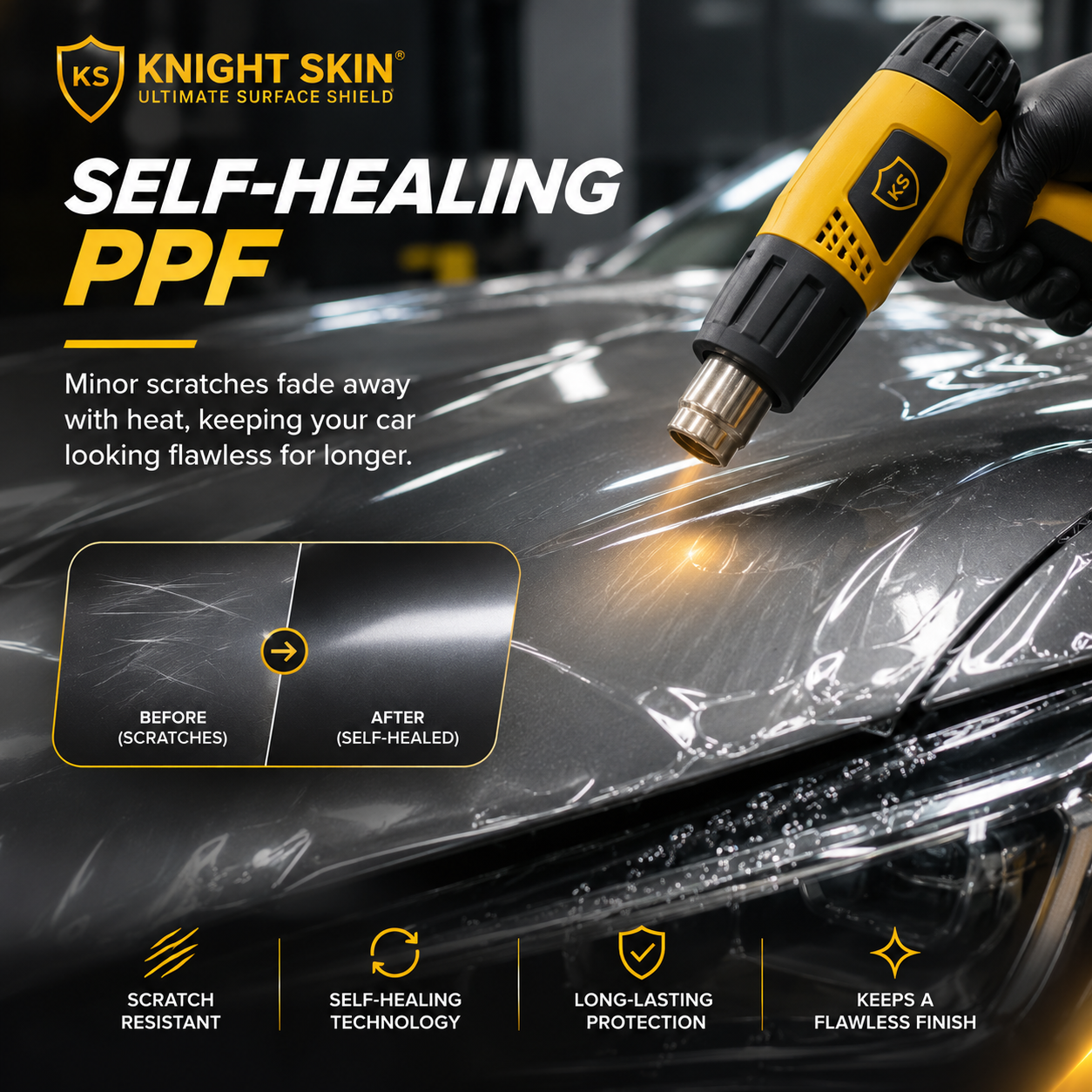
Quick answer: Self-healing PPF is a clear polyurethane film with an elastic top coat that flows back into shape when warmed by sunlight, warm water or a heat gun. It erases light swirl marks and fine scratches in the film itself, but it cannot fix deep gouges that cut through the top layer or any damage already in the paint.
What is self-healing PPF?
Paint protection film (PPF) is a thin, virtually invisible layer of thermoplastic polyurethane (TPU) applied over your car's painted panels. It takes the hits that would otherwise land on the paint: stone chips, road grit, light scratches and the everyday rubbing around door handles.
"Self-healing" describes the top coat of the film. On Knight Skin films, this self-healing layer is approximately 13 microns thick. It is designed to recover from light marks on its own, so the surface you see stays smooth and glossy for longer than bare paint or a basic film would.
How does self-healing PPF actually work?
The top coat is made from an elastomeric polymer, a material with a kind of "memory". When something drags across it lightly, the surface is pushed out of shape rather than cut away. The material is still there; it has just been displaced.
Add a little heat and the polymer chains relax and move back to their original, level position. The scratch becomes shallower and then disappears, because the surface has returned to flat. Nothing is being filled or polished; the film is simply recovering its shape.
That heat can come from several everyday sources:
- Sunlight: parking in the sun is often enough for fine wash marks to fade, which is easy in most Indian cities.
- Warm water: pouring warm (not boiling) water over the area can speed things up.
- A heat gun or hair dryer: installers use gentle, moving heat to help stubborn marks recover. Keep it moving and never overheat one spot.
- Engine heat: on the bonnet, normal driving warmth can help light marks relax.
What can self-healing PPF fix?
Self-healing works best on damage that stays within the top coat. In day-to-day use, that covers most of the marks that make a car look tired:
- Swirl marks from washing and drying with cloths or sponges
- Fine scratches from fingernails and rings around door handle cups
- Light scuffs from bags, keys, clothing and brushing past the car in tight parking
- Very light marks from small branches or bushes along narrow roads
- Light stone chips, where the stone dents the surface without breaking through the film
These are exactly the marks that, on unprotected paint, usually need machine polishing to remove. Polishing takes away a little clear coat every time, so avoiding it helps keep your factory finish intact for the long run. Our scratch protection film page explains which high-touch areas benefit most.
What can self-healing PPF not fix?
This is where honest expectations matter. Self-healing has a clear limit: if the top layer is penetrated, the film will not heal. Once material has been cut or torn away, there is nothing left to flow back into place.
- Deep gouges and key scratches: a deliberate key scratch or a sharp object dragged with force usually cuts through the top coat.
- Large or fast stone impacts: a heavy hit on the highway can puncture or tear the film. The film often still saves the paint underneath, but that spot of film will need replacing.
- Dents: PPF protects the surface, not the metal. A hard knock can still dent a panel under the film.
- Damage that was already in the paint: PPF does not repair existing chips, scratches or swirl marks in your paint. Anything not corrected before installation will stay visible under the film.
- Stains and chemical etching left too long: bird droppings, tree sap and harsh chemicals should be cleaned off promptly rather than left to bake on.
The good news is that a damaged section of PPF can be removed and a new piece fitted, which is far simpler than repainting a panel. That is the real job of the film: to be the sacrificial layer, so your paint does not have to be.
How can you tell if a scratch will self-heal?
A simple test is the fingernail check. Run a fingernail gently across the mark. If your nail glides over it and you can barely feel it, it is probably a surface mark in the top coat and is likely to fade with heat.
If your nail catches in a groove, or you can see a torn edge or a white line, the mark has probably gone through the top layer. Try warming it first, and if nothing changes, ask your installer to inspect it.
How do you help self-healing PPF last?
The self-healing coat works best when the film is kept clean and cared for. Knight Skin recommends a few simple habits:
- Wait around 7 days after installation before the first wash, so the film can settle and bond.
- Use only pH-neutral car care products, and avoid harsh chemicals containing petroleum, kerosene or naphtha.
- If you use a pressure washer, keep it around 2-3 feet away from the film edges to prevent lifting.
- Apply a liquid spray-on wax once a month or after washes, which helps stop bug splatter and tree sap from sticking.
- Use clean microfibre cloths and a two-bucket wash to reduce the swirl marks the film has to recover from in the first place.
For a wider care routine, see our guide on how often your car should be detailed.
Is every Knight Skin film self-healing?
The KS Series films are self-healing TPU films, available in gloss (KS 100, KS 300, KS 400, KS 500) and matte or satin finishes (KS 250, KS 350, KS 450, KS 550). The finish and warranty change between tiers, while the protective film base is the same.
Warranty terms run from 6 years (KS 100 and KS 250) to 8 years (KS 300 and KS 350), up to 10 years (KS 400 and KS 450) and lifetime for the limited-edition KS 500 and KS 550, available at select locations. Every tier is warrantied against cracking, peeling, yellowing, hazing and bubbling. Compare them on the KS Series range page.
Get Knight Skin PPF installed
If you want swirl-free, chip-resistant paint without constant polishing, talk to an authorised installer near you. Find a Knight Skin installer or get a quote and they will help you pick the right film and coverage for your car.
Frequently Asked Questions
Does self-healing PPF need sunlight to work?
Sunlight is one of the easiest ways to trigger it, but any gentle heat works. Warm water or a heat gun used carefully by your installer can also help light marks recover. In hot Indian weather, many fine wash marks fade simply from the car being parked outdoors.
Can self-healing PPF remove existing scratches on my paint?
No. Self-healing only repairs marks in the film's own top coat. Scratches, swirls or chips already in the paint stay visible under the film, so they should be corrected by paint correction before the PPF is installed.
Will a key scratch heal on PPF?
Usually not. A key scratch made with force normally cuts through the self-healing top layer, which is approximately 13 microns thick. Once that layer is penetrated, the film will not heal, but the damaged section can be replaced without repainting the panel.
How long does the self-healing effect last?
The self-healing property is part of the film's top coat, so it keeps working as long as that coat is intact and cared for. Regular washing with pH-neutral products and avoiding harsh chemicals helps the film perform well throughout its warranty term.
Is matte PPF also self-healing?
Yes. The KS Series matte and satin films (KS 250, KS 350, KS 450 and KS 550) use the same protective film base as the gloss films, so they share the same self-healing behaviour for light marks while giving a flat, matte look.